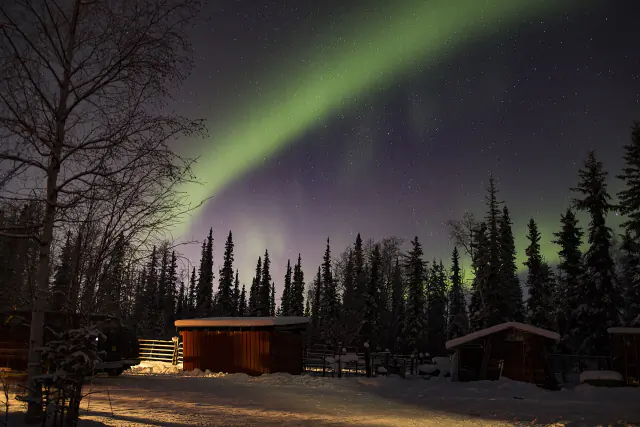
Northern Lights Destination
Northern Lights in Yellowknife, Canada
Yellowknife sits directly beneath the auroral oval, offering over 240 nights of northern lights activity each year — making it the undisputed aurora capital of North America.
Why Yellowknife Is the Aurora Capital of North America
Yellowknife's position at 62.45°N places it squarely beneath the auroral oval, the ring-shaped zone around the magnetic north pole where aurora activity is most concentrated. Unlike many northern destinations that sit at the edge of this zone, Yellowknife is centered within it, meaning the northern lights appear directly overhead rather than hovering near the horizon.
The city benefits from a subarctic continental climate that delivers remarkably clear skies. The Northwest Territories experience far less cloud cover than coastal aurora destinations, with winter months often producing crisp, cloudless nights ideal for viewing. NASA has recognized Yellowknife as one of the best places on Earth to see the aurora borealis.
With a KP index requirement of just 2, even modest geomagnetic activity produces stunning displays here. During strong solar storms, the aurora can fill the entire sky from horizon to horizon, dancing in greens, purples, and occasionally rare reds. Visitors staying three nights or more have a 95% chance of witnessing the northern lights.
Best Time to See the Northern Lights in Yellowknife
The prime aurora season in Yellowknife runs from mid-August through mid-April, with the peak months being September, October, January, February, and March. The autumn equinox (late September) and spring equinox (late March) are statistically the most active periods due to favorable solar wind geometry.
Winter viewing from November through February offers the longest dark hours, with nights stretching 18 hours or more in December. However, temperatures regularly plunge below -30°C, so proper arctic clothing is essential. Many visitors prefer the shoulder seasons — September and March — when temperatures are more moderate (-5°C to -15°C) and aurora activity remains excellent.
Summer months (May through July) are unsuitable for aurora viewing due to the midnight sun, which keeps skies too bright. However, a brief window in August as darkness returns can catch early-season displays reflected beautifully on unfrozen lakes.
Top Aurora Viewing Spots Around Yellowknife
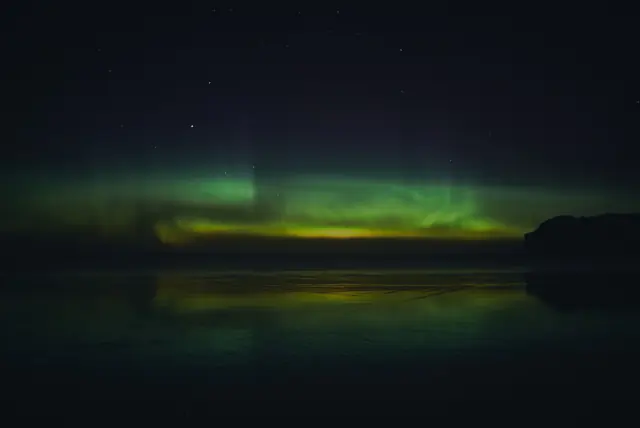
Prelude Lake is perhaps the most iconic aurora viewing location near Yellowknife, situated about 30 km east of the city along the Ingraham Trail. The lake provides a stunning foreground for photography, with aurora reflections in the still water creating mirror-image displays during autumn months before freeze-up.
The Aurora Village is Yellowknife's premier dedicated aurora viewing facility, featuring heated teepees, photography services, and warm beverages. Located on the shores of Vee Lake, this purpose-built site offers 360-degree views of the sky with minimal light pollution.
For those seeking solitude, Cameron River Falls on the Ingraham Trail provides a dramatic natural setting. The combination of waterfalls and boreal forest creates extraordinary photo compositions. Prosperous Lake and Pontoon Lake offer additional remote viewing opportunities accessible by winter road.
Within the city, Bush Pilots Monument on the Rock provides elevated views over Yellowknife Bay, though light pollution from the city reduces visibility compared to out-of-town locations.
Aurora Tours and Experiences in Yellowknife
Yellowknife has developed a thriving aurora tourism industry with experiences catering to every comfort level and budget. Guided minibus tours are the most popular option, with local operators driving small groups to the best viewing locations based on real-time weather and aurora forecasts.
For a uniquely Canadian experience, consider a dog sled aurora tour that combines mushing through the boreal forest with aurora viewing at a remote wilderness camp. Snowmobile excursions offer another way to reach pristine dark-sky locations while enjoying the thrill of riding across frozen lakes.
Photography-focused tours pair participants with professional aurora photographers who provide guidance on camera settings, composition, and post-processing techniques. Many operators supply tripods and hot drinks to keep you comfortable during long shooting sessions.
Houseboat stays on Great Slave Lake during autumn offer the remarkable experience of watching the aurora from the water, with displays reflecting off the lake surface. Several indigenous-operated tours incorporate Dene cultural teachings about the northern lights, adding a rich cultural dimension to the experience.
Getting to Yellowknife and Practical Tips
Yellowknife Airport (YZF) receives daily flights from Edmonton, Calgary, and Vancouver via Canadian North and WestJet. Booking flights well in advance during peak aurora season (December–March) is advisable, as routes fill quickly with aurora tourists from around the world.
Accommodation ranges from downtown hotels like the Explorer Hotel and Chateau Nova to wilderness lodges and B&Bs on the outskirts of the city. During peak season, booking 3–6 months ahead is recommended. Many hotels offer aurora wake-up calls to rouse sleeping guests when the lights appear.
Winter visitors must prepare for extreme cold. Layered clothing, insulated boots rated to -40°C, hand warmers, and balaclavas are essential. Several tour operators provide full arctic clothing rental, which is ideal for visitors who don't own extreme cold-weather gear. Camera batteries drain rapidly in the cold, so bring spares and keep them warm inside your jacket.
Plan the trip
Getting to Yellowknife
Aurora trips need three things booked together: a flight into the right airport, somewhere dark to stay, and usually a car, because the sky you get is the sky above wherever you can drive to that night.
Compare flightsLive fares into Yellowknife Airport (YZF), the closest airport to Yellowknife.
Affiliate links. Booking through them costs you nothing extra and helps keep this site running.
Borealis App
Aurora forecasts, social feed & Hunter Ranks
Frequently Asked Questions
A minimum of three nights is recommended, which gives you approximately a 95% chance of seeing the northern lights. Four to five nights is ideal, as it accounts for potential cloudy evenings and increases your odds of witnessing a truly spectacular display rather than just a faint glow.
March is often considered the best single month, offering a good balance of long dark hours, statistically high aurora activity around the spring equinox, and slightly warmer temperatures than mid-winter. September and October are also excellent, with the bonus of aurora reflections on unfrozen lakes.
Winter temperatures in Yellowknife regularly drop to -25°C to -35°C, with extreme cold snaps reaching -45°C or colder. Wind chill can make it feel even more extreme. Full arctic clothing is essential, including insulated boots, multiple layers, and face protection.
Yes, strong displays are visible from within the city, particularly from elevated spots like Bush Pilots Monument. However, for the best experience with vivid colors and fine details, traveling 20-30 minutes outside the city along the Ingraham Trail significantly improves the view by eliminating light pollution.
You can absolutely see the aurora independently by driving the Ingraham Trail to spots like Prelude Lake. However, guided tours offer advantages including expert knowledge of the best conditions, heated shelters, warm drinks, and aurora photography assistance. For first-time visitors, a tour for at least one night is highly recommended.
Yellowknife is generally safe for tourists. The main risks are weather-related — extreme cold, icy roads, and remote wilderness conditions. Always dress appropriately for the cold, let someone know your plans if venturing out on the Ingraham Trail at night, and ensure your vehicle is winterized with an emergency kit.
Related Articles
Destination
Northern Lights in Whitehorse
Whitehorse, the capital of Yukon Territory, is a vibrant gateway to northern aurora viewing. Nestled in a valley along t...
Destination
Northern Lights in Inuvik
Inuvik sits just above the Arctic Circle in the Northwest Territories, making it one of the northernmost accessible comm...
Destination
Northern Lights in Dawson City
Dawson City, the legendary Klondike Gold Rush town at the confluence of the Yukon and Klondike Rivers, offers some of th...