
Forecast
Aurora Forecast: How to Read Space Weather Data
Understanding KP index, Bz component, and the NOAA 30-minute model transforms aurora hunting from guesswork into science.
Real-time aurora forecasts, 250+ location guides, and everything you need to witness the greatest light show on Earth — free in your pocket.
251+
Location Guides
15
Countries
24/7
Live Forecasts
Soon
Borealis App
Borealis App — Coming Soon
Real-time NOAA forecasts and a Smart Aurora Probability Score tell you exactly when to go outside. A social feed, Hunter Ranks, global leaderboard, and Groups keep you connected to the aurora hunting community all winter long. Borealis is in the final stages of development and lands on the App Store soon.
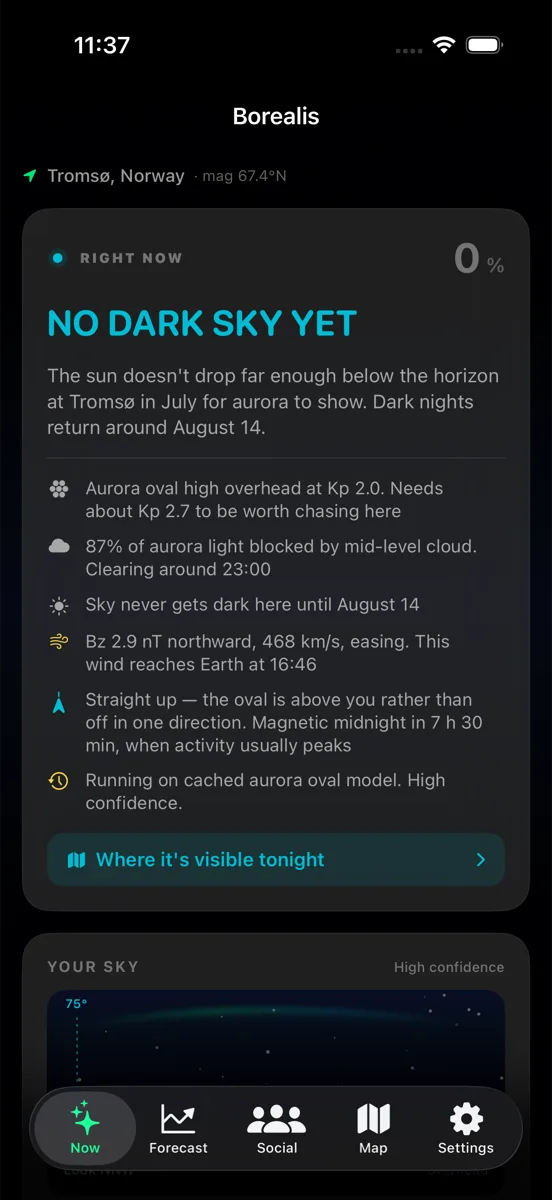
Now
Tonight's aurora probability, and why
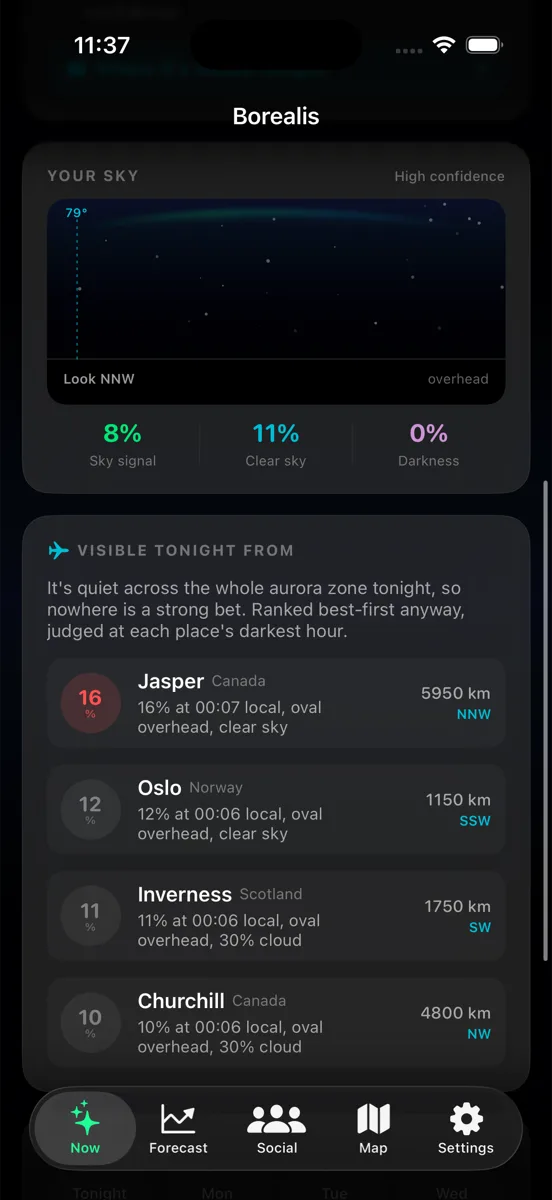
Your sky
Where it is visible tonight, ranked
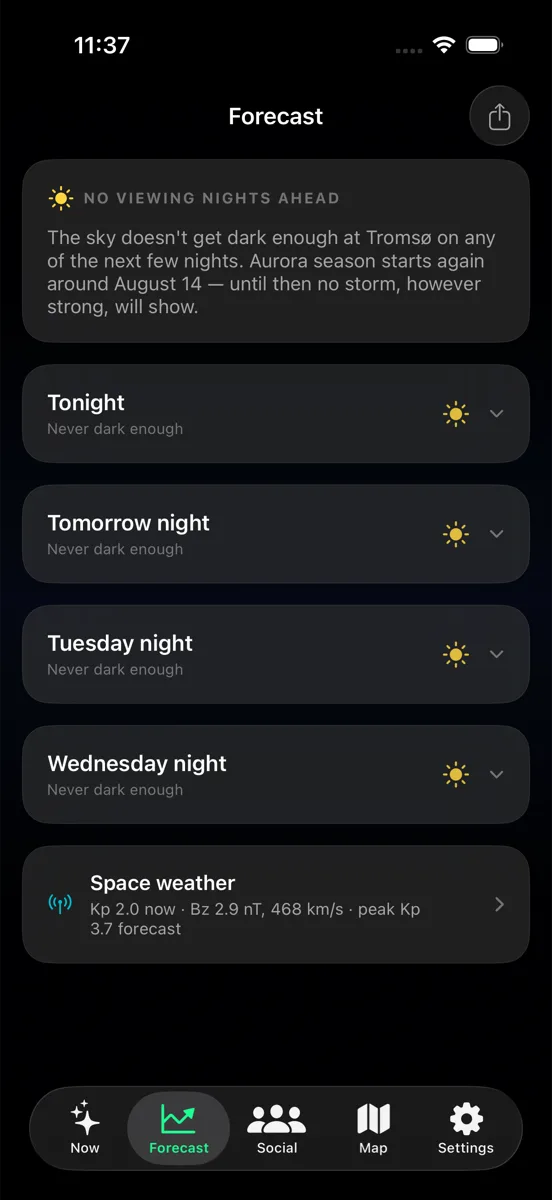
Forecast
The next four nights, each judged separately
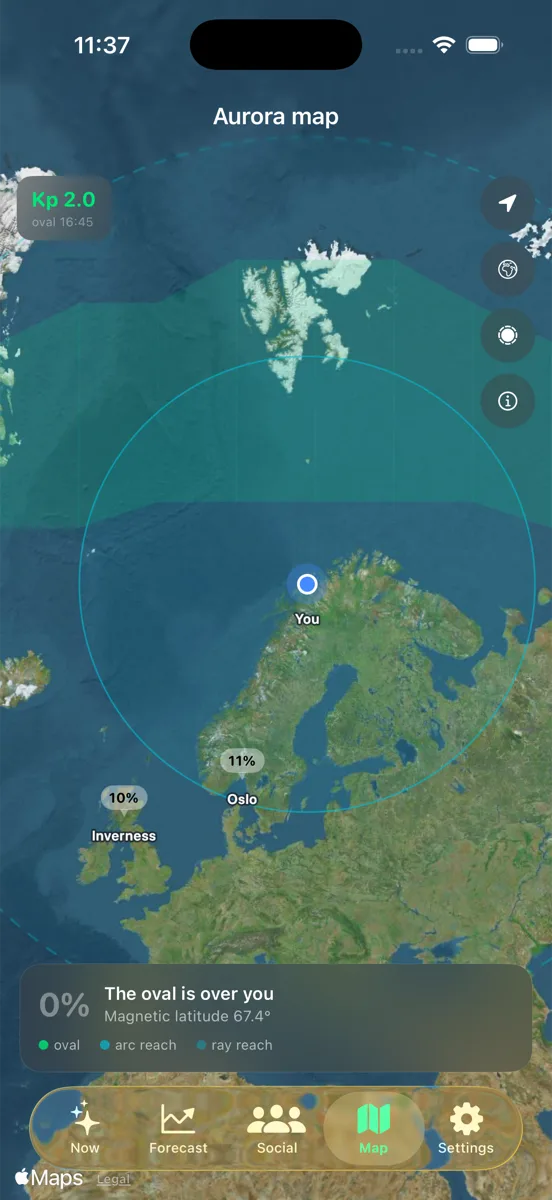
Map
The live oval, and how far south it reaches
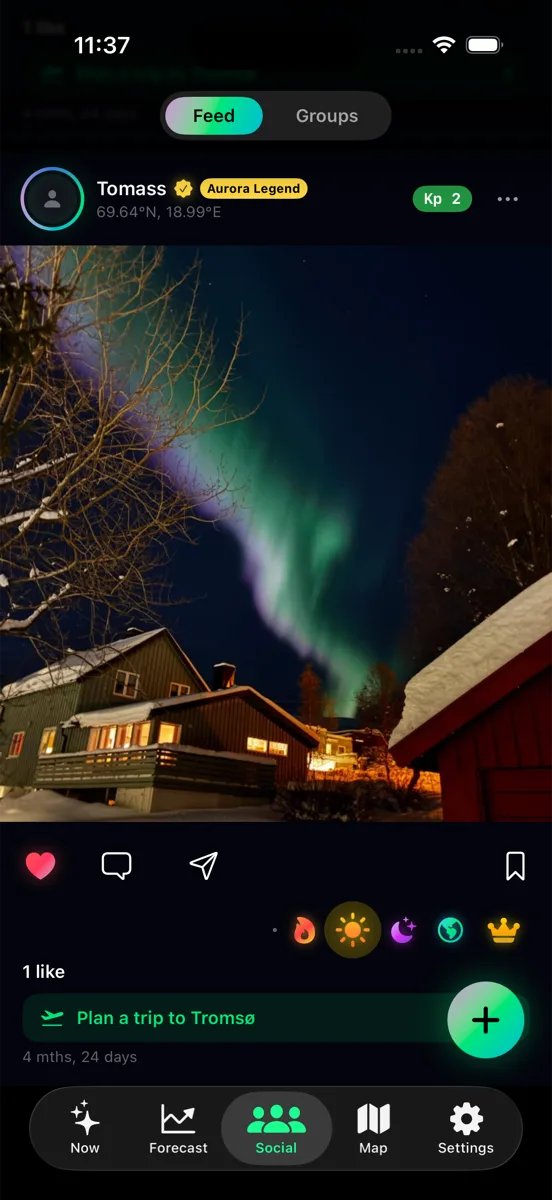
Social
Sightings tagged with the Kp they were shot at
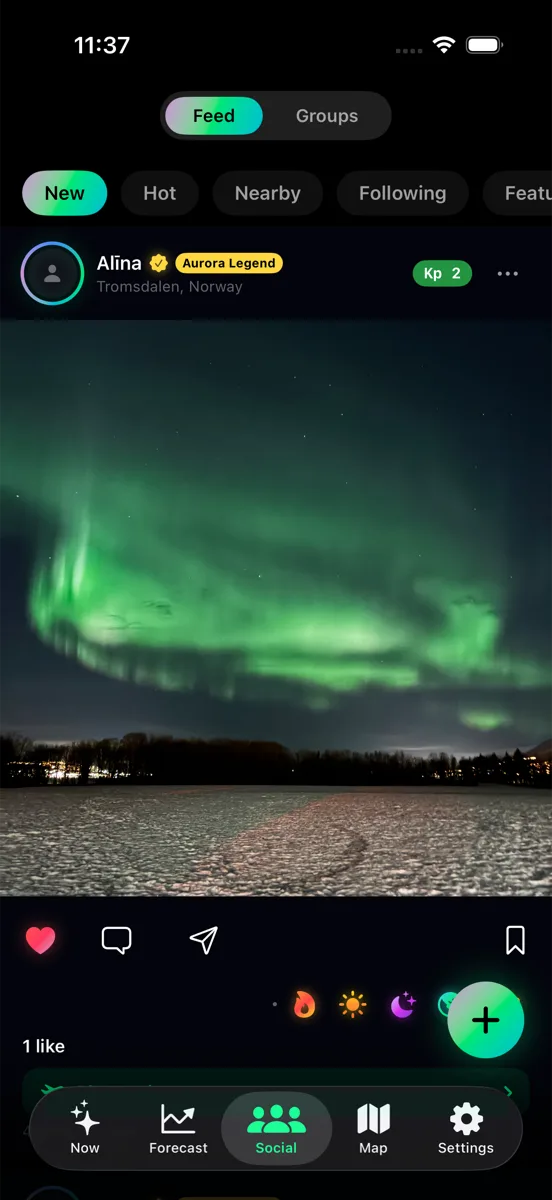
Community
Filter the feed to hunters near you
Guides
Forecast
Understanding KP index, Bz component, and the NOAA 30-minute model transforms aurora hunting from guesswork into science.
Planning
The equinox effect, solar cycle peaks, and why February–March often outperforms the polar night months for aurora reliability.
Destinations
From Svalbard at 78°N to Scotland at 57°N — a ranked guide to aurora viewing destinations by reliability, scenery, and accessibility.
Science
Solar wind, magnetic reconnection, and why oxygen at 100km altitude glows green. The physics behind Earth's greatest light show.
Southern Lights
Everything you need to know about the southern lights — where to see them, how they differ from the borealis, and the best forecasting tools.
Photography
Camera settings, lens choices, and composition techniques for capturing the northern lights from ISO to shutter speed.
Destinations
From the Arctic Circle to the southern tip of New Zealand, these destinations offer the world's best conditions for witnessing the aurora borealis and aurora australis.
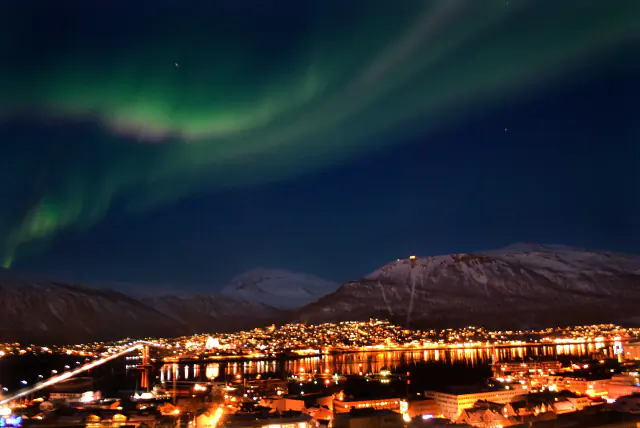 69.7°N
Best months: Sep, Oct, Nov
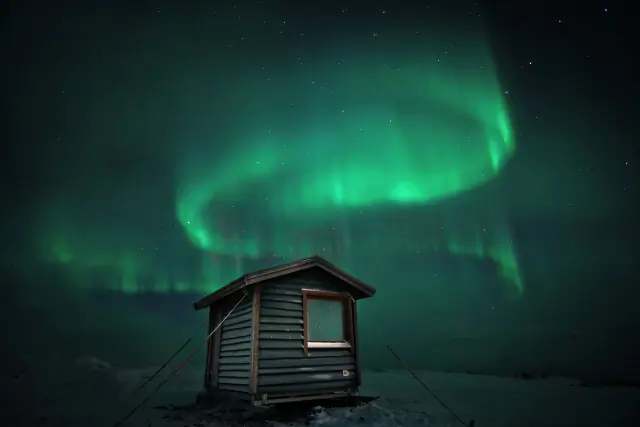 68.3°N
Best months: Oct, Nov, Jan
 66.5°N
Best months: Oct, Nov, Dec
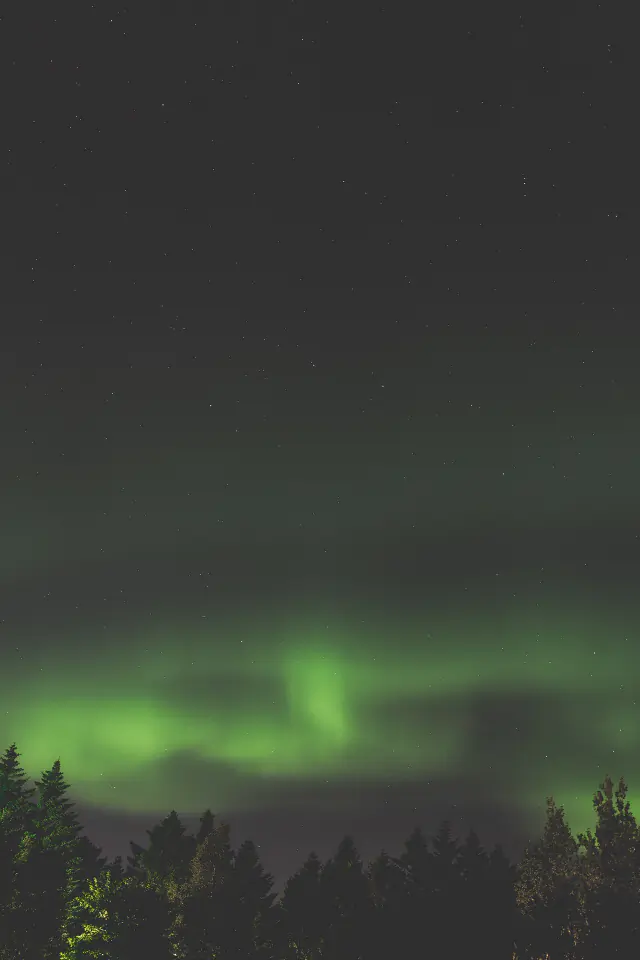 64.2°N
Best months: Sep, Oct, Feb
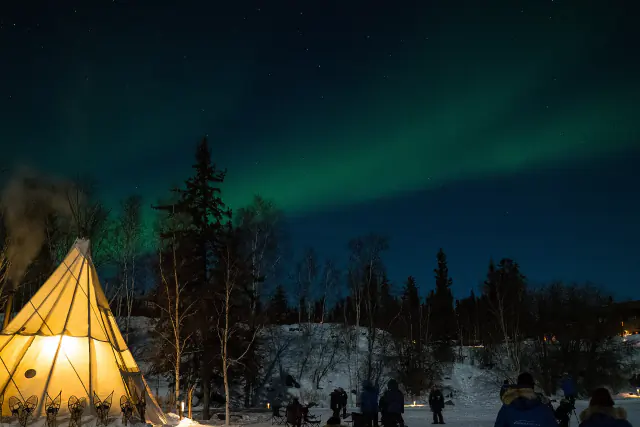 62.5°N
Best months: Oct, Nov, Jan
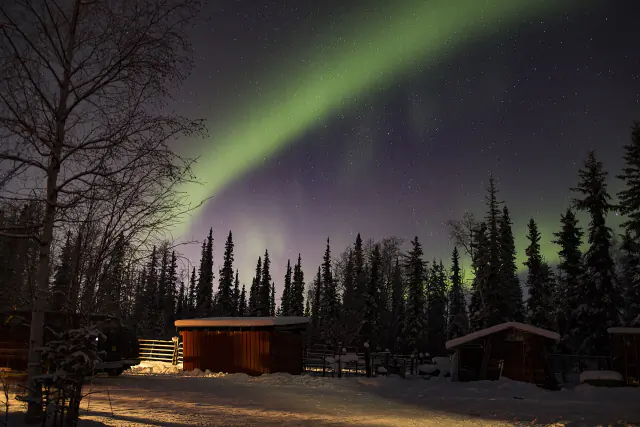 64.8°N
Best months: Sep, Oct, Nov
Forecast Tools
By Country
Northern lights and aurora borealis are two names for the same phenomenon. 'Aurora borealis' is the scientific Latin name — 'aurora' from the Roman goddess of dawn, and 'borealis' meaning northern. The term 'northern lights' is the common English name. Both refer to the luminous natural light display that occurs in high-latitude skies when charged solar particles interact with Earth's magnetic field and atmosphere.
The aurora borealis is caused by charged particles — mostly electrons and protons — streaming from the sun as solar wind. When these particles reach Earth, most are deflected by our magnetic field. However, near the polar regions, the magnetic field lines converge and funnel particles into the upper atmosphere. There, they collide with oxygen and nitrogen atoms at altitudes of 80–300 km, exciting those atoms into higher energy states. When the atoms return to their ground state, they release energy as visible light — the aurora. The colour depends on the gas and altitude: green from oxygen at ~100 km, red from oxygen at 200+ km, and blue/purple from nitrogen.
The best places to see the northern lights lie within or near the auroral oval — a ring roughly 65–72° latitude around the magnetic north pole. Top destinations include Tromso (Norway), Abisko (Sweden), Rovaniemi (Finland), Reykjavik (Iceland), Yellowknife (Canada), and Fairbanks (Alaska). Within these regions, you need dark skies away from city lights, clear weather, and sufficient geomagnetic activity.
Aurora can occur at any hour of the night, but statistically the most active period is between 10 PM and 2 AM local magnetic time. In practical terms, this typically falls between 9 PM and 1 AM local clock time at most high-latitude destinations. The aurora can also appear earlier in the evening during strong geomagnetic storms. Your best strategy is to stay out for at least 2–3 hours during the peak window rather than checking once and going inside.
The KP index is a global scale from 0 to 9 that measures geomagnetic activity. A KP of 0 means very quiet conditions with aurora confined to the highest Arctic latitudes. KP 3–4 means aurora is reliably visible across Scandinavia, Iceland, and northern Canada from dark-sky locations. KP 5+ indicates a geomagnetic storm with aurora potentially visible from Scotland, the northern United States, and central Europe. KP 7+ can push aurora into Germany, France, and the northern contiguous US.
No — or extremely rarely. The aurora happens year-round at high latitudes, but during summer months (May–July), the sky never gets dark enough to see it. The midnight sun creates continuous twilight or full daylight at arctic latitudes. Aurora season runs from late August/early September through late March/early April when true darkness returns.
Yes — our Aurora Forecast app provides real-time KP index data, push notifications when aurora activity rises, location-based forecasts, and cloud cover integration. Borealis, our own aurora app, is in development and arrives on the App Store soon. No app can guarantee aurora sightings, but they dramatically improve your chances by alerting you to the right conditions at the right time.
Ready to See the Northern Lights?
Check tonight's forecast, find the perfect destination, and download our app to get instant alerts when aurora activity peaks.